
Why Human Interior Designers Still Matter in the Age of AI
By Nureed Saeed, Founder and Creative Director, Nu Interiors
AI and Interior Design: Inclusive Promise or Inequitable Future?
AI is knocking at the door of interior design. And honestly? I have a lot of feelings about it.
On one hand, I believe deeply that good design should be accessible to everyone. Not just people with a $250,000 kitchen budget. The idea of tools that help more people visualize their spaces and make thoughtful decisions about their homes, that genuinely excites me.
On the other hand, I have spent my entire career fighting for design that actually sees people: their cultures, histories, bodies, and stories. And what I see AI doing right now is reflecting a very narrow version of what “good design” looks like. If we are not careful, we are not democratizing design. We are just scaling the same inequities, faster and at a much larger scale.
So let’s talk about it.
AI in Interior Design: Hype vs. Reality
AI in interior design is having its HGTV moment. Remember when Bob Vila and the DIY Network convinced an entire generation they could renovate their whole house over a weekend? AI is doing something similar. It creates the impression that beautiful, functional design is simply a matter of the right tools and a detailed prompt.
DIY culture expanded access to ideas and information. But it also showed us, pretty quickly, that tools do not replace expertise. And the same is true here. AI reflects the society that built it. A society that is still grappling with inequity, bias, and environmental accountability.
Without human designers to interpret, question, and contextualize what these tools produce, AI will repeat the same mistakes our industry has always made. Just faster, and at a much larger scale.
Can AI Truly Democratize Interior Design?
I want to be fair here, because I think it matters. AI-powered platforms are doing some genuinely good things. They are giving renters, first-time homeowners, and small business owners access to design visualization in ways that were not possible before. That matters. A lot.
But accessibility is not the same thing as equity. As a Bay Area interior designer working with clients in Berkeley, Oakland, Marin, and beyond, I know firsthand how differently design tools land depending on who is using them and what their actual lives look like.
Access to a free tool means very little if that tool was never built with you in mind.
The Hidden Equity Gap in AI Design Tools
Here is something that rarely makes it into the conversation about how great AI is: these systems learn from data. And that data overwhelmingly comes from people with stable internet access, technological fluency, and dominant language command (aka the user speaks English as their first language).
Which means AI design tools are, at their core, reflecting the aesthetic priorities of a very specific slice of humanity. Non-Western aesthetics? Largely absent. Culturally specific design traditions? Mostly overlooked. The lived experiences of people who do not fit the mainstream mold? Not in the training data.
Plus, the features that are most personalized and culturally attuned often sit behind a paywall. So the people who most need design tools that truly see them are the least likely to access the version that actually does.
That is not democratization. That is the same old hierarchy with a better interface.
AI and Accessible Design: Promise vs. Practice
Accessible design is one of the areas where AI has the most potential and where it is currently falling the shortest.
Accessibility is not a checklist. It is not just ADA compliance or grab bars in the right spots. It is designing for the full range of human experience: mobility differences, sensory needs, cognitive differences, neurodiversity. It is about creating spaces where people do not have to fight their own homes just to move through them with dignity.
AI has shown real promise in assistive technology. Real-time image descriptions, speech recognition, navigation tools. These are genuinely exciting developments. But models trained without meaningful input from people with disabilities are going to miss things. Critical things. They will default to ableist norms and overlook barriers that are invisible to anyone who has not lived with them.
Disability scholars have been saying for years that disability should be understood as a social issue, not just a medical one. The problem is not the person. It is the environment that was never built for them. Without that perspective baked into AI development, we are just automating the same barriers that have always existed.
True universal design, the kind that creates spaces usable by the widest range of people regardless of ability, age, or size, requires a human designer who actually listens. That is not something you can prompt your way into.
Bias, Homogenization, and Cultural Erasure
AI systems trained on dominant cultural norms tend to produce design outputs that reflect only mainstream aesthetics. Minimalist styles. Trend-driven color palettes. Generic furniture arrangements. This is not a small problem.
When a tool defaults to the same visual language over and over, it contributes to design homogenization. And when that happens, the traditions, aesthetics, and cultural practices that fall outside the mainstream get pushed further to the edges. The design industry has struggled with this long before AI arrived. AI just accelerates it.
I think about this a lot. I have had so many clients come to me carrying stories in their spaces, things that mattered deeply to their families, to their cultures, to who they are. And they had been told, again and again, to start fresh. Clear it out. What I see is that when we build tools that only recognize one kind of beauty, we are sending that same message at scale.
When we homogenize design, we erase culture, history, and people. That is a loss I take seriously. I always say, there is a designer for everyone…and the right designer sees you, not just your square footage.
The Environmental Cost of AI in Design
Let’s talk about something that rarely makes it into the “AI is amazing” conversation: the environmental footprint.
Training AI models and running data centers requires enormous amounts of energy and water. In drought-prone regions, and hello, we live in California, those water demands are not abstract. They compete directly with communities that are already fighting for access to clean, safe drinking water.
Sustainability has always been central to how I practice. I ask where products come from, how they are made, what happens to them at the end of their life. Why are we throwing things away when they can be refinished, repurposed, given a new life? That question matters to me in design, and it matters when it comes to the tools we choose to use.
If AI is consuming resources at scale and those costs are falling disproportionately on the most vulnerable communities, that is not just an environmental issue. It is an equity issue. Tech companies need to own that impact rather than expecting the broader public to absorb it.
Why You Still Need a Human Interior Designer
I want to be clear: I am not anti-AI. I am pro-people. And right now, AI does not do people the way people do people.
Here is what I bring to an interior design project that no algorithm can replicate:
Culture and context. I want to know what your grandmother’s antiques mean to you. What your mornings feel like. What kind of light makes you feel like yourself. That context shapes everything about a design. AI does not have access to it, and it does not know what to do with it even when it does.
Accessibility advocacy. I do not design just to code. I design for the specific person who will live in the space. Their mobility, their sensory experience, the way their body actually moves through a room. That requires a real conversation, real observation, and a genuine commitment to seeing someone fully.
Ethical judgment. Where did this tile come from? Was it made ethically? Is this product supporting or harming the environment? I tell my clients: if I brought you something, I would put it in my own home with my own children. That is the standard I hold myself to. That kind of judgment cannot be automated.
So much of what I do comes down to one thing: I try really hard to see people. Their stories, families, cultures, and needs. All of us want to be seen, and a well-designed home is one of the most powerful ways to make someone feel that they are.
The Bottom Line
AI will keep evolving. Some of what it is doing is genuinely useful and I am not asking anyone to ignore it.
But I am asking all of us, designers, clients, and tech developers alike, to hold it accountable. To ask who built it, whose data trained it, who benefits from it, and who gets left out. Because design that does not ask those questions is not just aesthetically hollow. It causes real harm.
At Nu Interiors, my whole practice is built around a different idea. Every person deserves a space that has been thought about carefully, designed with intention, and built to reflect who they actually are. Not who an algorithm thinks they should be.
If that sounds like what you have been looking for, I would love to talk.
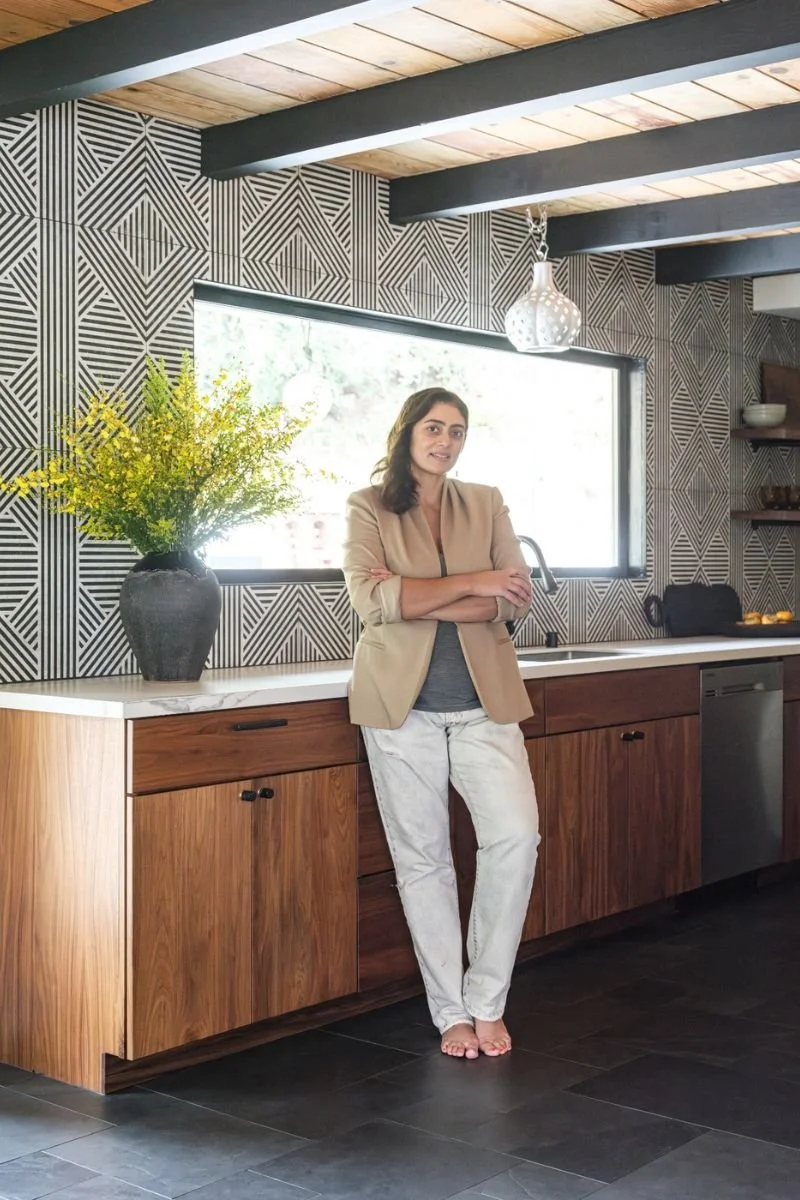
About The Author
Nureed Saeed is the Founder and Creative Director of Nu Interiors, a holistic, purpose-driven interior design studio based in Berkeley, CA. She serves clients across the Bay Area, including Oakland, Marin, Walnut Creek, and the 680 corridor, with additional work in New Jersey. Her practice is rooted in equity, sustainability, neuroaesthetics, and emotionally intelligent design. She is a member of NKBA and ASID and has been featured in the Wall Street Journal.
Book a consultation at nuinteriors.net
Citations:
Association of Collegiate Schools of Architecture. (2025, September 18). Where Are My People? Disability in Architecture - Association of Collegiate Schools of Architecture. https://www.acsa-arch.org/resource/where-are-my-people-disability-in-architecture